Aim
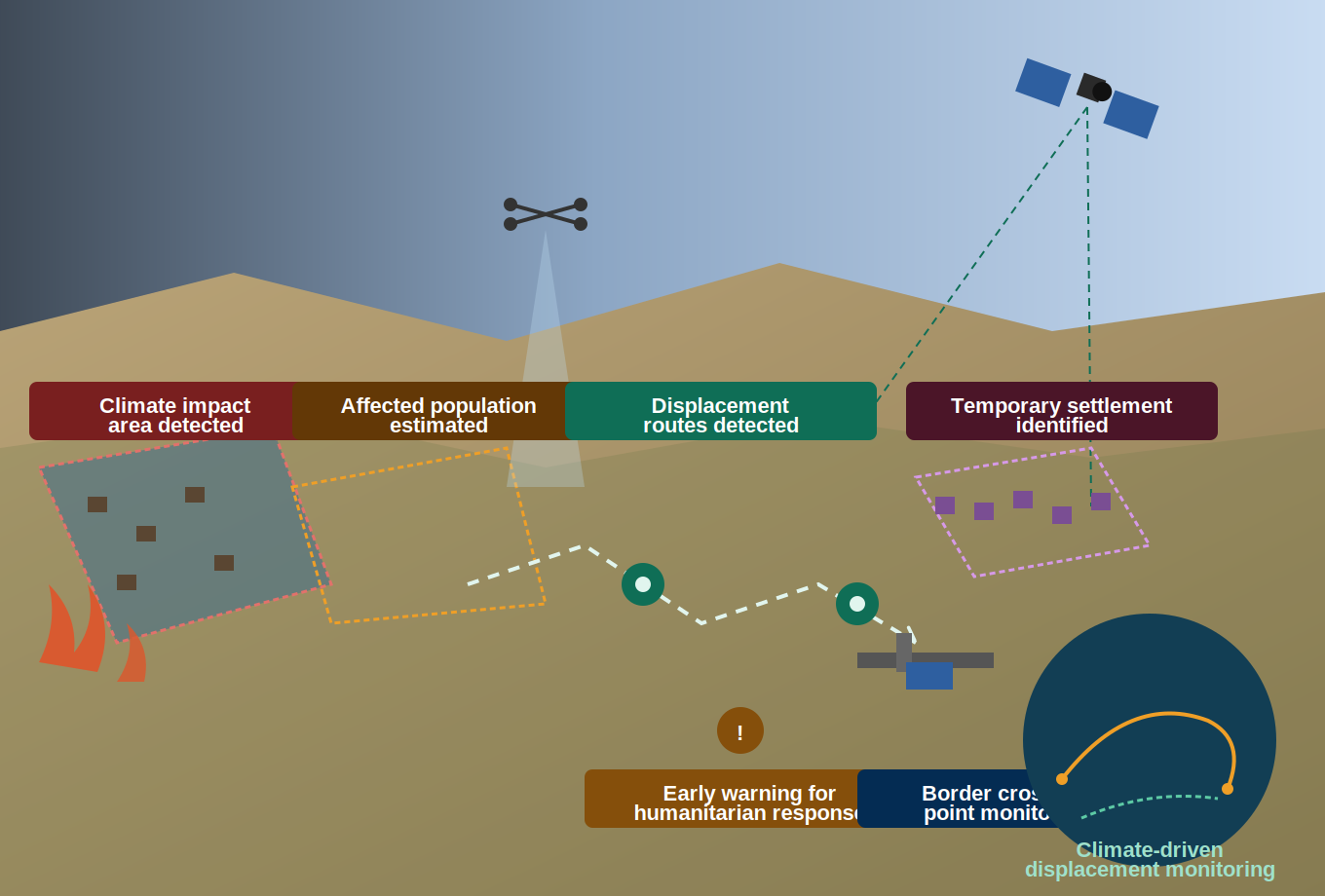
PUC3 focuses on identifying areas at risk from climate change and extreme events, as well as automatically detecting and delineating affected regions. The objective is to estimate the number of impacted people and support decision-making for humanitarian assistance, population protection, and governmental response planning. In addition, THEIA will monitor the displacement of affected populations and track emerging migration routes toward the vicinity of the EU’s external borders, providing relevant information to support PUC2 activities. The use case relies primarily on satellite imagery, including high- and very-high-resolution optical and SAR data, to assess the extent and severity of affected areas and identify new displacement zones. Copernicus services, particularly C3S, will provide seasonal forecasts and long-term climate projections to strengthen preparedness and risk assessment. Additional datasets, such as nighttime light imagery and thermal satellite data, may be used depending on the event type and operational requirements. PUC3 analyses three key dimensions: the number of affected people, the timing of events (duration and frequency), and their spatial distribution (diffuse or concentrated impacts). Open-source information from national authorities and international organizations, combined with satellite observations, will be integrated into the THEIA platform to assess event magnitude and support operational response.
Objectives
The main objectives are the capability of THEIA to provide to this PUC3 the geospatial information on the total number of displaced people, as well as geospatial products on the size of the affected area and its surroundings with urban areas, critical infrastructure and border points. The benefits from this PUC3 will improve the monitoring of environmental and humanitarian conditions at borders as well as other relevant areas of interest, anticipate and respond to climate-related crises such as natural disasters or resource scarcity that may affect security and humanitarian crisis situations, as well as contribute to global stability and environmental sustainability.